



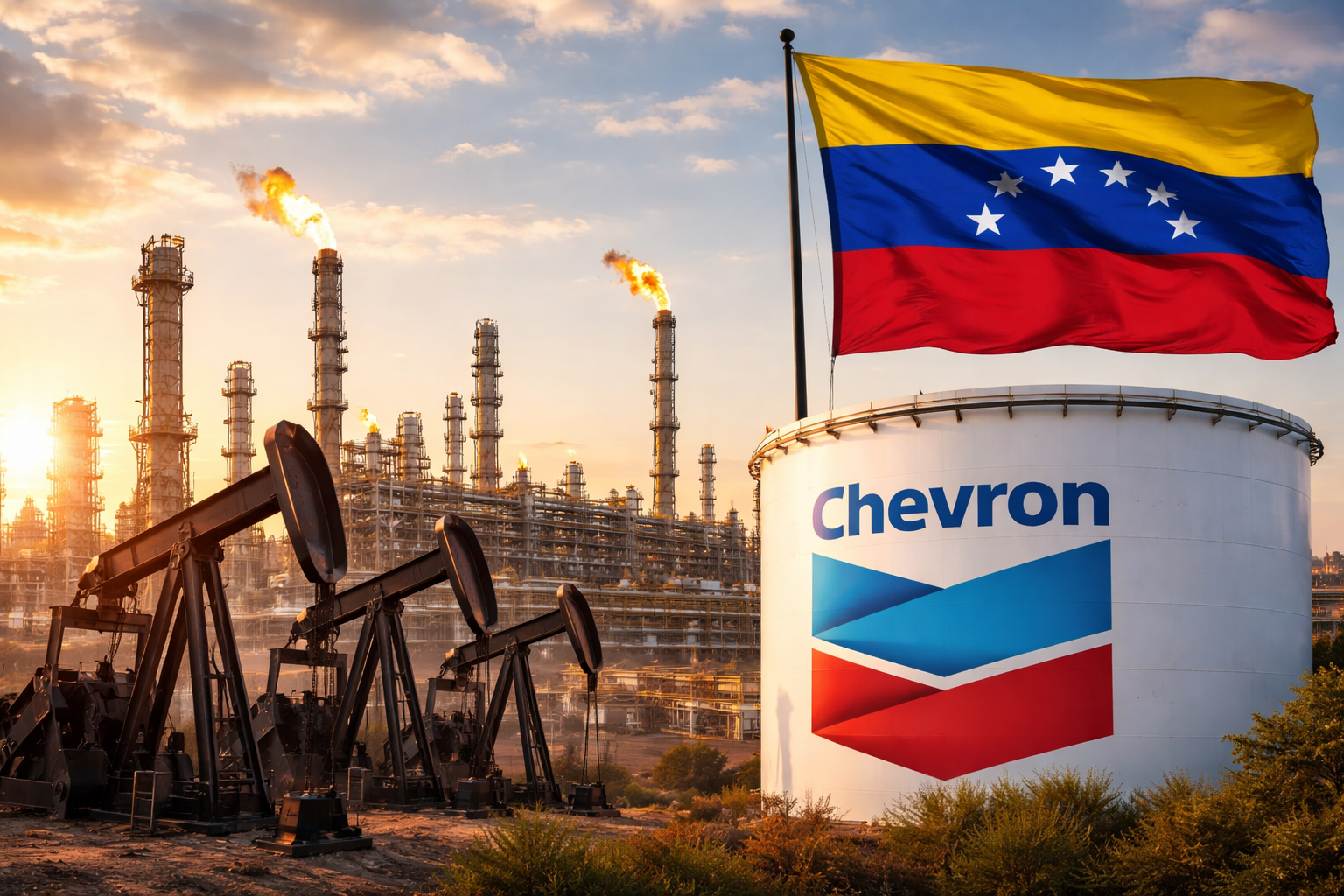
Shares in Chevron surged in premarket trading on Monday after the surprise removal of Venezuelan leader Nicolás Maduro over the weekend fuelled optimism that US oil companies could regain broader access to the country’s vast crude reserves.
Chevron stock was up about 7.8% before the opening bell, reflecting investor expectations that a change in government could ease long-standing operational constraints in one of the world’s most oil-rich nations.
ConocoPhillips also climbed sharply, rising nearly 9% to $105.02, as markets speculated that other US producers could eventually return.
The rally followed a dramatic military operation early Saturday that ended Maduro’s rule, an event President Donald Trump said would open the door for American energy companies to re-enter Venezuela after years of strained relations with Washington.
Speaking at a press conference at his Mar-a-Lago resort, Trump said the removal of Maduro would allow US companies to help rebuild Venezuela’s broken oil infrastructure while generating profits for the country.
“We’re going to have our very large United States oil companies, the biggest anywhere in the world, go in, spend billions of dollars, fix the badly broken infrastructure, the oil infrastructure, and start making money for the country,” he said.
The move marks what could be a pivotal moment for global energy companies.
The last comparable opening of a major oil producer occurred in Iraq, where auctions for oilfields attracted multibillion-dollar bids about six years after the US-led invasion in 2003.
Chevron uniquely placed among US majors
Chevron is currently the only major US oil company operating in Venezuela and is the country’s largest foreign investor.
Analysts at JP Morgan said an easing of restrictions under a new government could allow Chevron to expand operations and lift Venezuelan oil production, which has been crippled by years of mismanagement and underinvestment.
Chevron currently operates through joint ventures under a special licence issued by the Trump administration.
Venezuela is producing around 900,000 barrels of oil a day this year, according to industry estimates, with Chevron responsible for roughly one-third of that output.
Production had plunged to as low as 665,000 barrels per day in 2021, down from a peak of 3.7 million barrels per day in 1970, before staging a modest recovery in 2024.
According to Francisco Monaldi, director of the Latin America Energy Program at Rice University’s Baker Institute in Houston, Chevron is best positioned to benefit immediately from any opening.
However, other US oil companies, he said, are also likely to watch developments closely before committing capital.
“The company that probably will be very interested in going back is Conoco, because they are owed more than $10 billion, and it’s unlikely that they will get paid without going back into the country,” Monaldi said.
Exxon Mobil could also return, though it is owed less than ConocoPhillips, he added.
“Exxon, Conoco and Chevron, the three of them are not going to be worried about investing in heavy oil, given that it’s very much needed in the United States and that they have less focus on decarbonization,” Monaldi said in a Reuters report.
European companies may be more hesitant to invest in the prolific Orinoco Belt, he added.
Industry blindsided by military action
Despite Trump’s public encouragement, the Financial Times reported that the three US oil majors have greeted calls for renewed investment with caution.
Concerns include Venezuela’s history of expropriations, lingering political instability and the enormous sums required to restore output.
An industry insider told the Financial Times that executives at Exxon Mobil, Chevron and ConocoPhillips were blindsided by the US military action that led to Maduro’s removal.
“None of the industry players that have the capital and the expertise to invest in Venezuela were advised or consulted prior to either the removal of Maduro or the president making his statements,” the insider said.
Chevron said in a statement on Saturday that its immediate focus was on the safety of its employees and the integrity of its assets in the country.
The company and its joint ventures employ around 3,000 people in Venezuela.
Even with political change, significant hurdles remain
Western energy companies are drawn to Venezuela’s abundant and relatively low-cost resources, but analysts say any meaningful surge in investment will depend on political stability and credible assurances on contract enforcement.
Further complicating matters, Venezuela owes Exxon Mobil, ConocoPhillips and Chevron billions of dollars in unpaid joint-venture costs and arbitration awards.
Settling these liabilities is widely seen as a prerequisite for renewed large-scale investment.
Even if political, legal and financial obstacles are resolved, developing new oil and gas projects would take years.
Rapidan Energy estimates that Venezuelan production could rise by up to 200,000 barrels per day in the first year after Maduro’s ouster and potentially reach 2 million barrels per day within a decade under its most optimistic scenario.
Broader economic rebuild needed
José Ignacio Hernández, a law professor and consultant at Aurora Macro Strategies, said oil companies remain interested in Venezuela’s reserves but will not rush back without broader reforms.
“Oil companies always want oil, and Venezuela has a lot of it,” he said in a Wall Street Journal report.
“But they need political stability, which requires more than just removing Maduro. The situation is still ongoing.”
Orlando Ochoa, a Caracas-based economist and visiting fellow at the Oxford Institute for Energy Studies, described the scale of the challenge facing any new government.
Tens of thousands of trained energy professionals have left the country, and infrastructure has fallen into disrepair.
In comments reported by the Wall Street Journal, Ochoa said Venezuela would need a comprehensive economic stabilisation plan, changes to local laws to limit state overreach, restructuring of roughly $160 billion in debt and the settlement of outstanding arbitration cases to attract foreign investment.
“What the US needs to do is to implement a form of a Marshall Plan,” Ochoa said. “This is about much more than coming into the oil and gas sector just to extract crude from the ground.”
The post Chevron shares jump as Maduro’s fall puts US oil major in pole position for Venezuela oil appeared first on Invezz